Sunday, 1 September 2013
Brioche shawl: casting off
One third done - and then all the loose ends to take care of... Still, it's worth the trouble to make it look the way I have in mind. Hopefully, there is enough yarn left, but I think so!


Thursday, 29 August 2013
Camel cowl
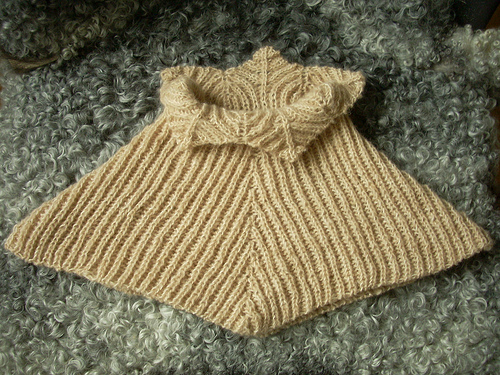
I've finished the cowl I mentioned in my previous post. The wool is lovely, 90% camel and 10% merino, and turned out to be perfect for brioche knitting. Not that I'm looking forward to winter, but at least I feel well prepared with this fluffy dream in my wardrobe. (And perhaps I could try my luck as a fluffer in the yarn porn industry?)
The two sides don't look quite the same when you (or at least when I) knit brioche in the round. The knit columns on the inside are more pronounced, but both sides look good.

Once I had cast off I couldn't resist casting on to make a similar cowl but with a different yarn from my stash, a single skein of gorgeous greenish blue. Isn't it fascinating how differently yarns respond to techniques? Brioche in the round is obviously not the right technique for this yarn - unless you want a distorted cowl.
Well, it could actually look nice with the spiralling effect - but it simply wouldn't work with the raglan shape, so I have to think of something else...
The camel wool reminds me of a happy Christmas a few years ago:


The two sides don't look quite the same when you (or at least when I) knit brioche in the round. The knit columns on the inside are more pronounced, but both sides look good.
Once I had cast off I couldn't resist casting on to make a similar cowl but with a different yarn from my stash, a single skein of gorgeous greenish blue. Isn't it fascinating how differently yarns respond to techniques? Brioche in the round is obviously not the right technique for this yarn - unless you want a distorted cowl.
 |
| cowl failure |
Well, it could actually look nice with the spiralling effect - but it simply wouldn't work with the raglan shape, so I have to think of something else...
The camel wool reminds me of a happy Christmas a few years ago:

Friday, 23 August 2013
Barking and burping
Those are Nancy Marchant's words based on the abbreviations brk (brioche knit) and brp (brioche purl). A voracious knitter I'm especially fond of burping.
I had no idea the technique had so many possibilities. In the photo there are three examples:
1. A two-colour shawl where the pattern is created using increases and decreases. (I discovered a mistake a few rows back, which is why I pulled out the needle. Irritating, but it gave me an opportunity to see how it is turning out.)
2. A single-colour cowl knitted in the round with increases and decreases to make a nice edge.
3. A two-colour swatch where the knit and purl columns change places; this affects which colour is brought forward.
I can't remember when I last learnt so many things in such short time - and I haven't even tried brioche cables or diagonal lines or...
Patentstickning är något jag har gillat sedan farmor lärde mig grunderna, men det är först nu jag har förstått vilka möjligheter som finns med tekniken. Eftersom jag egentligen bara kunde sticka fram och tillbaka med en färg (ett rätt misslyckat försök att sticka runt för några år sedan räknas knappast) tyckte jag att det blev för enformigt för att göra hela plagg, men nu har jag drabbats av patentfrossa.
Fotot visar tre varianter: en sjal med två färger där mönstret skapas med ökningar och minskningar; en fuskpolo som stickas runt och kanten formas med ökningar och minskningar; en provlapp med två färger där de räta och aviga kolumnerna byter plats, vilket innebär att det växlar mellan vilken av färgerna som blir dominant. Och det finns mängder kvar att testa!

I had no idea the technique had so many possibilities. In the photo there are three examples:
1. A two-colour shawl where the pattern is created using increases and decreases. (I discovered a mistake a few rows back, which is why I pulled out the needle. Irritating, but it gave me an opportunity to see how it is turning out.)
2. A single-colour cowl knitted in the round with increases and decreases to make a nice edge.
3. A two-colour swatch where the knit and purl columns change places; this affects which colour is brought forward.
I can't remember when I last learnt so many things in such short time - and I haven't even tried brioche cables or diagonal lines or...
Patentstickning är något jag har gillat sedan farmor lärde mig grunderna, men det är först nu jag har förstått vilka möjligheter som finns med tekniken. Eftersom jag egentligen bara kunde sticka fram och tillbaka med en färg (ett rätt misslyckat försök att sticka runt för några år sedan räknas knappast) tyckte jag att det blev för enformigt för att göra hela plagg, men nu har jag drabbats av patentfrossa.
Fotot visar tre varianter: en sjal med två färger där mönstret skapas med ökningar och minskningar; en fuskpolo som stickas runt och kanten formas med ökningar och minskningar; en provlapp med två färger där de räta och aviga kolumnerna byter plats, vilket innebär att det växlar mellan vilken av färgerna som blir dominant. Och det finns mängder kvar att testa!
Friday, 16 August 2013
Learning new tricks
At a knitting event a couple of weeks ago I was inspired to develop my brioche knitting skills. As I only knew the very basics of the technique, there was (and still is) a lot of room for improvement - and I had no idea what possibilities there are!
A workshop leader myself I couldn't participate in any classes, but when Nancy Marchant talked about brioche knitting and showed examples of what you can make with the technique I knew I had to try it. I’ve ordered her book Knitting Brioche, and while waiting for it to arrive I have taken her class at Craftsy. Highly recommended!
The shawl I’m making with two colours is based on a rectangular scarf pattern that is included in the Craftsy class. (Ravelry link here.) It is a fascinating technique in many ways, like the way you create patterns using increases and decreases.
When I knit lace shawls I like thinking of bricks of various shapes that build a shawl, and realized I could think in a similar way with these ”leaf bricks” constructing the shawl shape by adding leaves.
När jag var kursledare på Stickstämma 2013 i Jämtland för ett par veckor sedan kunde jag ju inte gå några kurser själv, men i programmet fanns fyra föredrag som alla kunde lyssna på. Bland annat pratade Nancy Marchant om patentstickning, och det var mycket inspirerande att se vad det går att göra med den tekniken! Jag lärde mig grunderna av farmor, men nu fick jag se många exempel på hur man kan arbeta med färger och skapa mönster med hjälp av ökningar och minskningar.
I väntan på hennes bok Knitting Brioche har jag lärt mig massor av Nancys nätbaserade kurs på Craftsy och börjat leka med en sjal. Bladet är från ett mönster som ingår i kursen, men jag ville se om jag kunde använda formen på ett annat sätt än i en halsduk. Det är roligt att passa ihop mönsterform och sjalform!

A workshop leader myself I couldn't participate in any classes, but when Nancy Marchant talked about brioche knitting and showed examples of what you can make with the technique I knew I had to try it. I’ve ordered her book Knitting Brioche, and while waiting for it to arrive I have taken her class at Craftsy. Highly recommended!
The shawl I’m making with two colours is based on a rectangular scarf pattern that is included in the Craftsy class. (Ravelry link here.) It is a fascinating technique in many ways, like the way you create patterns using increases and decreases.
When I knit lace shawls I like thinking of bricks of various shapes that build a shawl, and realized I could think in a similar way with these ”leaf bricks” constructing the shawl shape by adding leaves.
 |
| brioche shawl: wrong side |
I väntan på hennes bok Knitting Brioche har jag lärt mig massor av Nancys nätbaserade kurs på Craftsy och börjat leka med en sjal. Bladet är från ett mönster som ingår i kursen, men jag ville se om jag kunde använda formen på ett annat sätt än i en halsduk. Det är roligt att passa ihop mönsterform och sjalform!
Tuesday, 13 August 2013
Poly-Starmore-mania
First of all, thanks for birthday wishes! I had a very nice day and am fortunately far from suffering from any kind of midlife crisis. On the contrary, finding oneself knitting three different Alice Starmore designs must surely be a sign of extremely good health!
My most recently started Starmore design is "Henry VIII". There are more rows without colour changes than in Donegal and Alba, which makes it quicker to knit - and it is such a treat seeing the pattern take shape. I have just finished the first repeat. They consist of 64 rows, so there will be three in all and the shoulder join will be in the middle of the part with red background.
Here is a birthday present I'd like to share with you, a beautiful rose that Cecilia Levy sent me. Look at the petals! The medium-sized ones are all cut from pages no 40 - and the smaller ones inside them from no 39, like years unfolding. Too elegant for words.


My most recently started Starmore design is "Henry VIII". There are more rows without colour changes than in Donegal and Alba, which makes it quicker to knit - and it is such a treat seeing the pattern take shape. I have just finished the first repeat. They consist of 64 rows, so there will be three in all and the shoulder join will be in the middle of the part with red background.
Here is a birthday present I'd like to share with you, a beautiful rose that Cecilia Levy sent me. Look at the petals! The medium-sized ones are all cut from pages no 40 - and the smaller ones inside them from no 39, like years unfolding. Too elegant for words.

Thursday, 8 August 2013
A bouquet
Considering all the embroidered flowers I thought this would be a suitable photo to celebrate that I turn 40 today! Actually, it feels as if I've been on a birthday party for a week: I was a workshop leader at a fabulous knitting event 1-4 August, and there I made new friends. They had planned a tour of the region of Dalarna (Twined Knitting Heaven) for a few days and I was happily shanghaied. We had a great time together and got to see - and fondle! - lots of twined garments from the 1800s, like the ones in the photo above.
Needless to say, I managed to buy some z-ply yarn too!

Needless to say, I managed to buy some z-ply yarn too!
 |
| a bouquet |
Monday, 22 July 2013

.jpeg)
Sunday, 21 July 2013
"Alba" sleeves
Here is the shoulder join: it is identical to the one I made for the sweater I finished some time ago. The sleeve is different, though, as there is no sleeve cap shaped with short rows.
Ann asked how I made those: starting with seven stitches in the middle I knitted back and forth adding three stitches each row until I had knitted all the stitches picked up around the armhole and could start knitting in the round. I was happy with how it turned out, but didn't feel like knitting lots of purl rows with two strands this time.
Instead I concentrated on figuring out where to start in the pattern. My aim was to make sleeve match the body, so I knew exactly where in the pattern I wanted the sleeve to end - but I also wanted to start where it would look good (I don't like it when patterns look amputated, and these repeats consist of 40 rows) and get the length right, of course.
Jules asked about the Donegal border, whether it was my own or a new version by Alice Starmore. It is Starmore's, the one that you get with the kit. I modified it slightly, though: instead of casting on with the light colour I chose the darker one and added a couple of purl rows to make the edge curl inwards. There are photos of the original design here.

Ann asked how I made those: starting with seven stitches in the middle I knitted back and forth adding three stitches each row until I had knitted all the stitches picked up around the armhole and could start knitting in the round. I was happy with how it turned out, but didn't feel like knitting lots of purl rows with two strands this time.
 |
| Alba sweater: sleeve cap |
Instead I concentrated on figuring out where to start in the pattern. My aim was to make sleeve match the body, so I knew exactly where in the pattern I wanted the sleeve to end - but I also wanted to start where it would look good (I don't like it when patterns look amputated, and these repeats consist of 40 rows) and get the length right, of course.
 |
| Alba cardigan: body and sleeve |
Jules asked about the Donegal border, whether it was my own or a new version by Alice Starmore. It is Starmore's, the one that you get with the kit. I modified it slightly, though: instead of casting on with the light colour I chose the darker one and added a couple of purl rows to make the edge curl inwards. There are photos of the original design here.
Thursday, 18 July 2013
The more Starmore the merrier
My second Alba will be a cardigan - mainly because it allows me to change colours in the middle of the front steek and simply cut out the centre of the steek with all the threads. (I did a similar thing a couple of years ago.)
I happened to order a Donegal kit fromVirtual Yarns some time ago. Not because I'm worth it, but simply because I want it. This pattern is slightly trickier to knit: unlike Alba, there are often long floats to catch with both strands. Well worth it, though, as it is like knitting jewellery.
Don't you think the wool matches my William Morris tray?


I happened to order a Donegal kit fromVirtual Yarns some time ago. Not because I'm worth it, but simply because I want it. This pattern is slightly trickier to knit: unlike Alba, there are often long floats to catch with both strands. Well worth it, though, as it is like knitting jewellery.
 |
| Donegal |
Don't you think the wool matches my William Morris tray?

Sunday, 7 July 2013
The more "Alba" the merrier
Alice Starmore's "Alba" sweater had been waiting patiently for me for almost two years when I finally returned to it. I had picked up stitches around the armholes and knitted sleeve caps using short rows (my modification) but not the sleeves. Fortunately, I had finished both sleeve caps, so I didn't have to analyse the process as much as I feared.
Once I was back on track knitting the sleeves was pure joy! It is such a beautiful pattern and the colours are stunning. The sweater is not for me but for my friend Anders, but as soon as I had darned in all the loose ends I cast on to make another for but for my not quite sweaterless self.
Much as I love Alice Starmore's designs (and this one in particular) I also love experimenting. What I've changed knitting Alba no 2 is the colour sequence for the check border pattern: less contrast and a gradual change from darker to lighter shades.
Also, I've started the main pattern at a different row to keep using the shades of blue from the check pattern for the background. This in turn means I skipped the light horizontal lines in the original version. I like Starmore's better, but mine well enough to keep it.

.jpg) |
| Alba: sleeve decreases |
Once I was back on track knitting the sleeves was pure joy! It is such a beautiful pattern and the colours are stunning. The sweater is not for me but for my friend Anders, but as soon as I had darned in all the loose ends I cast on to make another for but for my not quite sweaterless self.
.jpg) |
| sleeve caps and armhole |
Much as I love Alice Starmore's designs (and this one in particular) I also love experimenting. What I've changed knitting Alba no 2 is the colour sequence for the check border pattern: less contrast and a gradual change from darker to lighter shades.
.jpg) |
| Alba no 2 (slightly modified) in progress |
Also, I've started the main pattern at a different row to keep using the shades of blue from the check pattern for the background. This in turn means I skipped the light horizontal lines in the original version. I like Starmore's better, but mine well enough to keep it.
.jpg) |
| Alba sweater |
Saturday, 29 June 2013
"Mystic" sweater: reknitting sleeves
To my immense surprise, the sleeves turned out to be too long - actually, having long arms was a main reason for me to start modifying patterns. (Small/medium chest, medium/large shoulders, large/xl arm length... What was a poor, disproportionate guy to do? Develop his knitting skills, of course!)
Knitting sleeves top-down is a major advantage in cases like this: I only had to rip back and reknit a few inches, and only the shortest rows too. I think the new, shorter version looks better: the net starts in the centre of the panel and blends with the ribbing. (I often write "blend with", don't I? Something of an obsession, I guess.)

Sewing the shoulder strap in place took some time, but wasn't as tricky as I expected. It helps having a nice patch of garden to sit in - and the neighbours came for a cackling visit.
I always block sweaters inside out as I think it makes it easier to get the seams straight. Many instructions tell you to do the seaming after blocking the pieces, but I prefer having the boring bits over and done with as soon as possible.
And here is what the finished sweater looks like. I just can't capture the colour (no 4009), but here is a good photo.

Diana asked about whether the shawl pattern "Leaves Dancing" is available in English. Not that I know, I'm afraid - but at least lace charts are international.

Knitting sleeves top-down is a major advantage in cases like this: I only had to rip back and reknit a few inches, and only the shortest rows too. I think the new, shorter version looks better: the net starts in the centre of the panel and blends with the ribbing. (I often write "blend with", don't I? Something of an obsession, I guess.)

Sewing the shoulder strap in place took some time, but wasn't as tricky as I expected. It helps having a nice patch of garden to sit in - and the neighbours came for a cackling visit.
 |
| good neighbours |
I always block sweaters inside out as I think it makes it easier to get the seams straight. Many instructions tell you to do the seaming after blocking the pieces, but I prefer having the boring bits over and done with as soon as possible.
 |
| blocking |
And here is what the finished sweater looks like. I just can't capture the colour (no 4009), but here is a good photo.

Diana asked about whether the shawl pattern "Leaves Dancing" is available in English. Not that I know, I'm afraid - but at least lace charts are international.
Wednesday, 26 June 2013
Life at its worst...
...should be like this: visiting dear friends, lovely weather and a bag full of knitting projects. Not to mention - but not in the photo - a lake nearby, delicious food and a bottle of champagne. (But this being life at its best is certainly good enough!)

It took some time to decide what kind of neckband to make for the "Mystic" sweater. The original has a cabled one; you knit it separately and sew it into place, which makes it similar to St. Brigid. However, I thought a turtleneck would look nice, and something simple would let the anchors be in focus. The ribbing is the same as for the cuffs (3 knit, 2 purl) to make it blend with the cable patterns.
"Så här ska det vara när det är som sämst," som en god vän brukar säga när vi har det som trevligast!


It took some time to decide what kind of neckband to make for the "Mystic" sweater. The original has a cabled one; you knit it separately and sew it into place, which makes it similar to St. Brigid. However, I thought a turtleneck would look nice, and something simple would let the anchors be in focus. The ribbing is the same as for the cuffs (3 knit, 2 purl) to make it blend with the cable patterns.
"Så här ska det vara när det är som sämst," som en god vän brukar säga när vi har det som trevligast!
Wednesday, 19 June 2013
Gusset experiment

When I knitted St Brigid recently I added cables to the edges of the sleeves to make the seam as invisible as possible. I've done the same thing here, but developed the idea: the cables start at the bottom of the front and back pieces. When I got nearer to the armholes I added increases on each side of them to make a kind of gusset, and when I picked up stitches for the sleeves I added the gusset stitches. This way I could continue the cables without interruption.

The negative thing about it is that there is not only a cable but also a seam in the middle of the armhole, which might make it less comfortable than an ordinary gusset, but I wanted to give it a try anyway.
.jpg)
Kanske blir det lite obekvämt med en bred fläta med en söm i mitten i armhålan, men jag kunde inte låta bli att testa en idé jag fick. När jag stickade St Brigid nyligen lade jag till flätor i kanterna på ärmarna och tyckte att det blev snyggt - och då fick jag för mig att jag skulle testa att ha det så hela vägen från höft till handled. För att få en kilform under armarna ökade jag på var sida om flätorna och satte maskorna på trådar efter att jag hade kommit till ärmhålen. Sedan fortsatte jag på dem i samband med att jag plockade upp maskor för att sticka ärmarna.
Monday, 17 June 2013
A helping paw
Last weekend I was cat-sitting and made quite a lot of progress supervised by Puma.
I've kept the basic construction of Alice Starmore's design Mystic, but in a slightly different way. Instead of kniting the sleeves separately starting with the cuffs and ending with the shoulder straps, I started with the straps; when they were the right length I picked up stitches along the front and back and added the strap in the middle.

A pattern change is that I've added a net pattern to the sleeves. I think it works well with the anchors, and it is fairly easy to make it follow the shape of the sleeves.

I've kept the basic construction of Alice Starmore's design Mystic, but in a slightly different way. Instead of kniting the sleeves separately starting with the cuffs and ending with the shoulder straps, I started with the straps; when they were the right length I picked up stitches along the front and back and added the strap in the middle.

A pattern change is that I've added a net pattern to the sleeves. I think it works well with the anchors, and it is fairly easy to make it follow the shape of the sleeves.
Tuesday, 4 June 2013
"Mystic" sweater in progress
This is a really difficult colour to capture: in reality it's brighter, greener and bluer.
But not this bright (and the green doesn't show here):

Not that it matters much - the important thing is that it's enjoyable to knit, which it is.
Thanks for all your comments on my Aranish sweater! Summer arrived at long last, so I haven't worn it yet. My impression is that we practically skipped spring this year. Didn't I wear layers and layers of clothes only a few weeks ago? It's a good thing I'm not allergic to wool like one of my friends!

But not this bright (and the green doesn't show here):

Not that it matters much - the important thing is that it's enjoyable to knit, which it is.
Thanks for all your comments on my Aranish sweater! Summer arrived at long last, so I haven't worn it yet. My impression is that we practically skipped spring this year. Didn't I wear layers and layers of clothes only a few weeks ago? It's a good thing I'm not allergic to wool like one of my friends!
Subscribe to:
Posts (Atom)