Showing posts with label cardigan. Show all posts

Monday, 21 April 2014

Happy Easter!

Monsieur & Madame

A certain sign that spring is really here is that our feathered neighbours are allowed to roam the gardens freely.

I'm experimenting with a top-down cardigan using two strands of yarn. One is a wool-cotton blend and the other one is silk. This combination of fibres should make a nice summer cardigan!


The colour is so dark (darker than in the photos) I thought there wouldn't be much point in knitting lots of patterns, but a far better idea to bring out the beauty of the fibres with a lot of stocking stitch. Moss-stitch panels makes it more fun to knit, and the slightly elastic effect is an advantage if I don't get the size exactly right. Knitting it top-down is also a way to make it more interesting and challenging to knit.

Napoleon


Sunday, 16 February 2014

A rose is a rose...


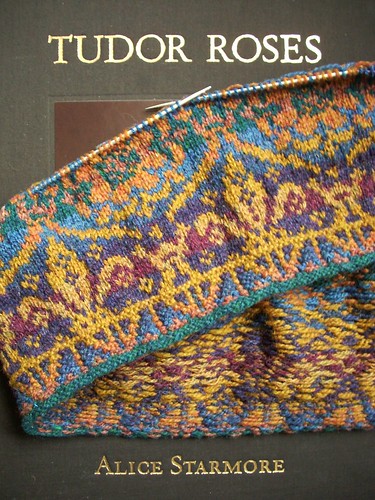
Fortunately, possibly not by pure accident, I had already bought the yarn to knit Alice Starmore's "Mary Tudor" when I decided to at least try not to add to my stash for a while. Still haven't bought any yarn this year!

Thanks for your comments on "Henry VIII"! His sister Mary is just as delightful to knit: the astonighingly beautiful pattern is slightly trickier, but still easier as there is only one chart to follow instead of three and fewer colours. But what colours! I've said it before and I'll say it again: Alice Starmore for president!

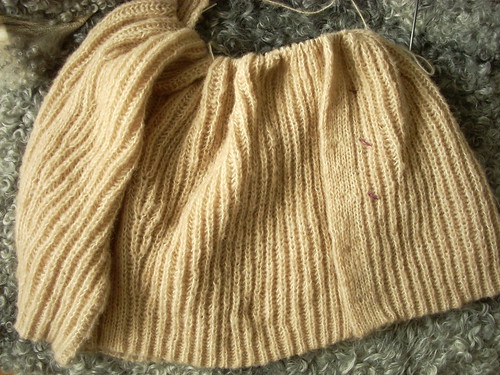
My other main project right now is completely different, a single-colour brioche cardigan with hardly any patterns, but then I'm a polygamous knitter - there's nothing like a pile of different kinds of project to be able to choose what I feel like, or start something new with treasures from my stash. (My relationship to books is similar: facts, fiction, classics, modern etc in tempting piles.)

brioche cardigan: raglan sleeve

The only thing you could call a pattern is a double-knitted column in the middle of the sleeves. The increases are on each side of the column instead of near the edges, which I think looks nice. I've been struggling with the shoulder straps, testing different versions.

testing shoulder straps

My first attempt was the strap to the right. I didn't like it, but didn't rip it out at once. Instead I knitted the one to the left first to be able to compare them. An improvement I thought would do - but then I saw the wrong side. That's what I wanted! So, I'll rip them both and reknit them inside out, so to speak. All's well that ends well.

wrong side soon to be right side

Wednesday, 29 January 2014

Brioche and double knitting

Camel cardigan in progress by Asplund
Camel cardigan in progress, a photo by Asplund on Flickr.
Unexpectedly, I haven't bought any yarn so far this year - nothing related to knitting, actually. Instead, I'm making - enjoyable - efforts to decide how to make use of what I've already got.

2013 was a brioche and double knitting year for me. I learnt the basics of brioche knitting as a child and always liked how it feels, but it was only after seeing Nancy Marchant's projects and reading her book Knitting Brioche that I began to understand its enormous potential. Last year I also decided to learn double knitting at long last, which took my knitting mind in new directions.

What I'm making now (among many other things) is a cardigan combining the two techniques: a brioche cardigan with double-knitted edges for buttons and buttonholes. Nancy Marchant's "The Book Exchange Cardigan" (Ravelry link) is my inspiration, but with some modifications.


This wool is 90% camel: wonderfully soft and incredibly warm. I live in an old building, which is incredibly charming but cooold. I love the colour, but I will probably look like my dear old teddy bear Åsanalle.

Last, some great advice which I forgot to bring up when I wrote about finishing my "Alba" cardigan recently.

Right before I started cutting the steeks I mercifully remembered the scissors needed to be cleaned carefully as I had been cutting fins off herrings earlier in the evening! So, don't forget to clean your herring-and-steeks scissors - unless you want your fishermen's sweaters as authentic as possible, of course.

Sunday, 22 January 2012

Shoulder joins - montering vid axlarna

shoulder straps by Asplund
shoulder straps, a photo by Asplund on Flickr.
It has taken me quite a few weeks to figure how to knit the shoulder straps to achieve what I have in mind: a strap that has the right width and length with a pattern that looks nice and will blend nicely with the sleeve pattern.

The cast-on is provisional: I will unpick it and use the live stitches to knit the neckband. I caught the live stitches of the last row when picking up stitches around the armhole to make the shoulder strap continue seamlessly into the sleeve.

My intention is to pick up stitches along the strap sides, knit a row and then do a three-needle bind-off to join strap and body. (Mainly to avoid sewing, but I think it will look and feel nice too.)


Natasha's cardigan is finished! In this case I used the three-needle bind-off method for a shoulder join and added a neck gusset - I learnt how to make such gussets from Alice Starmore's book Fishermen's Sweaters.

Three-needle bind-off and neck gusset; fram- och bakstycke avmaskade tillsammans och halskil.


If I may say so myself and I may, since this is my blog ;-) I think Natasha's cardigan is one of my best efforts! She won't receive it just yet, though. I will be talking about how I modify patterns at my LYS Litet nystan on 31 January, and this is a good example of it. Here's what the original design looks like. Nothing wrong with it - I just can't help changing a few things here and there.

This is possibly related to jazz being my favourite kind of music - I think it's so exciting hearing how the same composition can sound completely different (but still familiar) when different artists put their personal stamp on it. Or how the same artist can interprete the same composition in different ways.

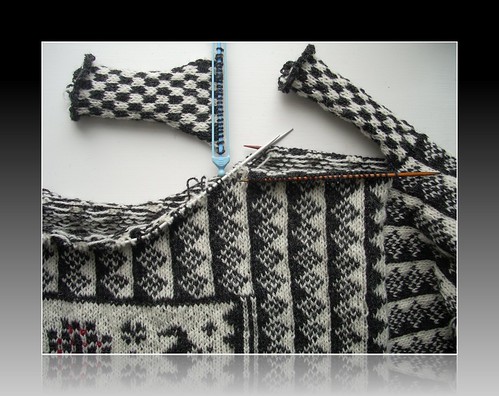
"Thorsten fiskares tröja" (bygger på ett mönster av Celia B. Dackenberg) har legat i träda ett par månader medan jag har funderat på hur jag skulle få till axlar och ärmar; jag visst hur jag ville att det skulle se ut, men det är ju inte alltid samma sak som att veta hur man ska bära sig åt. Å andra sidan är det sådant som jag tycker är roligt med stickning - när jag lyckas lösa problem känner jag att jag utvecklas. 

Jag tycker att sadelärmar är snyggt och bekvämt, och jag tyckte att det skulle passa på den här tröjan. Tricket var att få till rätt storlek med ett snyggt mönster som dessutom övergår på ett fint sätt i mönstret på ärmarna. Först gjorde jag en provisorisk uppläggning: den kommer jag att peta bort när det är dags att sticka halskanten, så att det inte blir någon skarv i övergången. När jag plockade upp maskor runt ärmhålet för att sticka ärmarna fångade jag upp sadeln på halva vägen, så att det inte blir någon skarv på den sidan heller.


För att fästa sadeln vid fram- och bakstyckena tänker jag plocka upp maskor längs kanten, sticka ett varv och sedan maska av dem tillsammans med maskorna på fram- respektive bakstyckena. 


Natasha's kofta blev klar nyligen och jag måste säga att jag är väldigt nöjd. Fotot ovan visar axeln: jag maskade av fram- och bakstycke tillsammans och kombinerade detta med en liten halskil. Detta är en finess jag lärde mig - som så mycket annat - i boken "Fiskartröjor" av Alice Starmore. 


Det dröjer ett par veckor innan Natasha får sin kofta. Den 31 januari kommer jag nämligen att prata om hur jag ändrar i beskrivningar när det är stickkafé på Litet nystan, och det här projektet är ett bra exempel att ha med. Inte för att det är något fel på originalet, tvärtom - jag kan bara inte låta bli!

Natasha's cardigan; unfortunately, the bad light doesn't do the colours justice.


Monday, 2 January 2012

Swenglish

My ambition is to start writing posts in both English and Swedish.

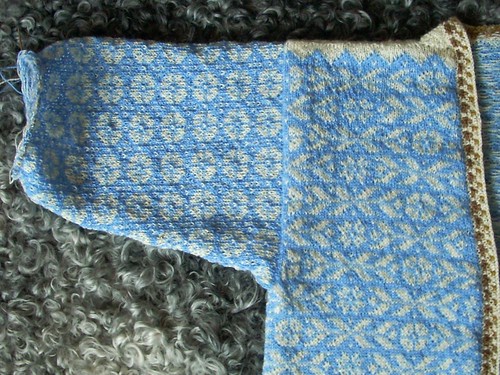
Here is what I came up with for the cardigan sleeves: I took the flower shape from the body pattern (to make the different sections work together) and added small dots between them (to make it easier to knit).

The pattern repeat consists of twelve rows and there are sleeve decreases every four rows. Three decreases in all repeats makes it easier to remember when it's time for them: I like it when pattern and shape go together.

For the cuffs I'm going to repeat the mustard leaves, the pearls and the picot edge from the body to frame the cardigan.

Till ärmarna har jag valt att plocka blomformen från kroppen och använda dem i ett slags rutmönster med små prickar mellan. Jag tänker mig att samma mönsterform gör att koftans olika delar passar ihop även om det inte är exakt samma mönster, och de små prickarna gör att det blir lättare att sticka. (Enklare att sticka en maska i mönsterfärgen än att sno trådarna för att undvika långa flotteringar.)

Ärmens mönsterrapport består av tolv varv och minskningarna ligger vart fjärde varv, alltså tre minskningsvarv per rapport; detta gör det enklare att hålla reda på när det är dags att minska. Jag gillar när mönster och form hänger ihop.


Muddarna kommer att bli som nederkanten på koftan (senapsgula blad, pärlor och uddkant) för att liksom rama in plagget. 


The vest designed by Hanne Falkenberg is finished. I'm really happy with how it turned out, but I'm not likely to knit it again. It wasn't difficult, but rather monotonous. A good project to work with on trains, though - and I think the design is fabulous!

Hanne Falkenbergs väst är klar, och jag är riktigt nöjd med hur den blev - men den var nog lite för enformig att göra för min smak även om den inte var svår. Konstruktionen är så sinnrik att det var givande att sticka den bara för den sakens skull.

A helping paw - en hjälpande tass.

Monday, 8 August 2011

Isager's Viften/The Fan finished

Seamed, blocked and handed over to Åsa. The size was right for her, and she was happy with the modified sleeve length! Turned inside out it looks like this.

I'm quite obsessed with Alice Starmore's "Alba", knitting like mad. (A phenomenon not particularly uncommon...) I've modified it by shaping the armholes to make it a little bit less too big (see earlier post) and will modifiy the neck too; I want it slightly deeper and narrower than the original design. How I wish the photo captured the colours! The gorgeous hints of different greens are lost, for example.

Alice Starmore's "Alba"
Today is the last day of my summer vacation, so I'd better make full knitting use of it. Actually, it's my birthday too: I'm going to treat myself to extra extra knitting time! How old? 38. Really good age - my best so far!

Wednesday, 3 August 2011

Isager's Viften/The Fan

Isager's Viften/The Fan by Asplund
Isager's Viften/The Fan, a photo by Asplund on Flickr.
Only seaming, darning and blocking left - and handing over to recipient, of course!

Yarn: BC Lucca Fino Tweed, 300 grams.
Needles: 3½ mm (US 4).


Modifications in short:
  • back and front sections knitted together instead of separately
  • slip stitches on right side (easier to see when to make them)
  • increases and decreases on wrong side (less visible)
  • type of border pattern decreases changed for a smoother look and feel
  • there is a choice between short and long sleeves, but Åsa wanted medium length; I’ve made them 90 rows long between border and armhole with increases 6 times every 6 rows and 5 times every 8 rows
  • border and back of neck grafted (Kitchener stitch) instead of three-needle bind-off to avoid a welt
  • an extra stitch added at each side for selvedge, and I’ve slipped the first stitch every row with yarn in front and knitted the second one
I also cast on a lot more loosely than in my first version of this design for the scalloped edge to be more pronounced, and I added a first row (purls on right side) for the edge to curl slightly.

If I make it a third time I will knit the border in the round to avoid a welt where the edges are seamed.

Monday, 1 August 2011

First sleeve done

There's a choice between short and long sleeves in the instructions; Åsa (who will get the cardigan) and I agree it would be nice with medium-length sleeves.

Here's my modified sleeve size if anyone's interested:

1. There are 90 rows from border to armholes.
2. Increases every 6 rows 6 times, then every 8 rows 5 times.

I've been adding to my collection of works in progress, starting Alice Starmore's "Alba" sweater. Stranded colourwork is really what I like best when it comes to techniques, especially knitting a pattern like this. You just can't beat her sense of colours - unfortunately, this photo does not do them justice.

I can't remember when I was this excited about a project last: it's a thrill seeing it take shape in my hands.

The only thing I can't understand is Alice Starmore's tension! I don't knit particularly loosely (don't think I've ever had to change needle sizes to get the gauge called for) but in this case I get 24 instead of 28 stitches per 10 cm (4 in) even though I use thinner needles, 3 mm instead of 3.25 (US 2½ instead of 3).

I could go down one more size but feel the sweater will be too stiff for my taste if I do. Instead, I'm following the directions for a size smaller than I want - and it will still be a bit too big!

Now, I love Alice Starmore's designs and would love to meet her and thank her in person for everything I've learnt and been inspired by - but judging from her tension I would hardly let her massage my shoulders ;-)

Monday, 24 August 2009

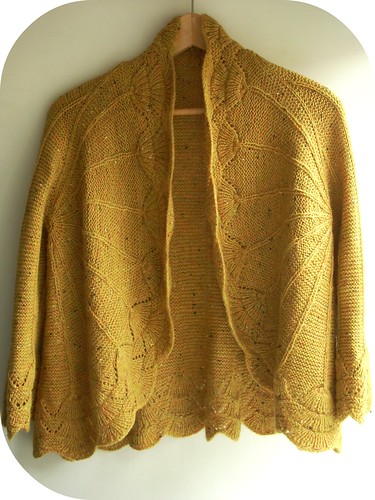
"The Fan" cardigan: finished


"The Fan" cardigan
Originally uploaded by
Asplund

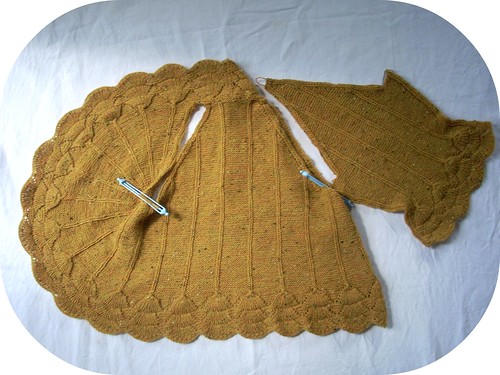
There is a choice between long and short sleeves, so I started knitting the short ones to be on the safe side. Almost done with the first sleeve, I thought there wouldn't be enough yarn for the second one after all; therefore, I decided to make them even shorter. (Not that much, perhaps 5 cm or 2 in.)

I always find it difficult to figure how much yarn will be needed (Ravelry has made that easier) and short raglan sleeves was simply impossible! At least I didn't have to rip out much.

The cardigan is for my friend Elisabeth, who introduced me to Marianne Isager's designs and yarns some fifteen years ago. I hope the size is right!

More pictures:


What I like best about this project is that I found the right use for the yarn. It was so annoying not having used it to its best advantage but not knowing what to knit instead! If I may say so myself, I think the yarn and this design are a great match – and hopefully Marianne Isager wouldn't mind my modifications too much. A man's got to do what a man's got to do.

ETA Errata (I believe)

1) right front rows 4-14: Rep Rows 1 and 2 should be Rep Rows 2 and 3 (p. 35)
2) left front rows 4-14: Rep Rows 1 and 2 should be Rep Rows 2 and 3 (p. 38)
3) left front row 71: k2-55 (64) st rem should be k3-55 (64) st rem (p. 38)
4) Shape Raglan Sleeve Cap: Work 3 rows even, then rep dec row 1 (5) times. Here I'd like to add that the dec has be sl1 k2tog psso the first (fifth) time instead of “k2tog, work in est patt to last 4 st, k2tog”. (p.41)

Friday, 21 August 2009

The Fan: progress

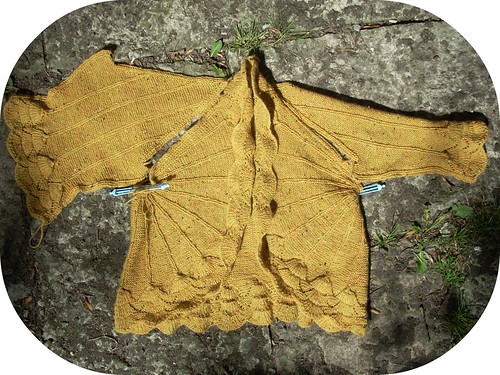
I didn't expect this to be such a quick knit; I've finished the back, and am half-way through the second front piece. I just hope there is enough yarn for both sleeves!

Perhaps that's why I'm speed knitting - to finish as much as possible before I run out of yarn? (I'm not always logical when it comes to knitting!) Anyone who recognizes this behaviour? Please?

I must say bourette silk bears reknitting extremely well. After all, I frogged the vest after two years, but that yarn isn't much different from what was left unused. Still, I do hope there is enough to finish this cardigan so I don't have to frog and reknit once more.

Tuesday, 18 August 2009

Recycling

"The Fan" is one of several intriguing designs in Marianne Isager's gem of a book Japanese Inspired Knits.

Increasingly (ha ha...) eager to knit it I suddenly remembered an almost finished vest in a suitcase in my mother's basement (sounds like an episode of “Prime Suspect”) that I’ve been doing my best to forget for some two years, but was suddenly happy to remember now. A yarn bonus!

The vest looks better than I thought – but not good enough to finish. I tried it on, but even though it is actually comfortable I'm not likely to wear it, partly because I prefer wearing wool to bourette silk, material I hadn't worked with before and was curious about (and I couldn't resist the colour). What's more, I don’t like how it turned out enough to give it to someone else. It's a good thing I didn't weave in the loose ends!


Would you believe it, even though this yarn is nothing like what the instructions call for and I used slightly thinner needles to knit a swatch, I got the right gauge! What could I do but cast on the real thing?

For photos of a beautiful finished "Fan" cardigan, check out Dances with wool.